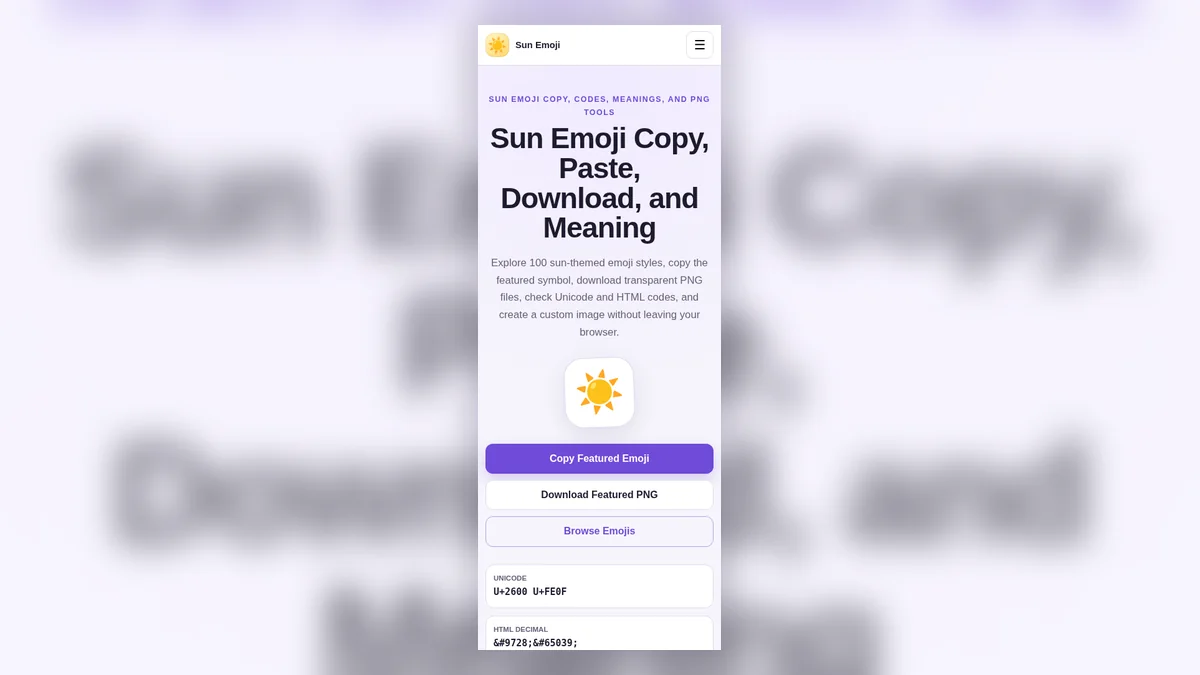
Find Sun Emoji Unicode, HTML decimal, hexadecimal, variation selector, shortcode, encoding, and rendering information. This article explains practical context, platform behavior, and reliable ways to use the symbol clearly.
Core Unicode value
The classic sun character uses Unicode code point U+2600. Unicode assigns the abstract character, while fonts and platforms decide how it looks. This separation explains why the same text can appear as a black symbol in one application and a colorful emoji in another.
The character belongs to the older Miscellaneous Symbols block, which is why it has broad support beyond modern emoji keyboards.
Emoji variation selector
U+FE0F is the variation selector commonly used to request emoji presentation. When it follows the sun character, the sequence asks a compatible system to use colorful emoji artwork. U+FE0E requests text presentation, although application support and font selection still influence the result.
Variation selectors are invisible formatting characters. Copying only what appears on screen may include or omit them depending on the source.
HTML decimal and hexadecimal entities
The decimal entity for the core sun is written as ☀. The hexadecimal entity is written as ☀. To include the emoji variation selector, add ️ or ️ immediately after the core entity.
A modern UTF-8 HTML document can also contain the literal character. Entities are useful in source code, documentation, or systems where typing the character directly is inconvenient.
Shortcodes and platform aliases
Shortcodes are not part of Unicode. They are text aliases interpreted by a specific platform, editor, or library. A common alias is :sunny:, but another service may use a different name or support no shortcode at all.
Do not assume a shortcode will work outside the platform where it was defined. The Unicode character is more portable.
Encoding and troubleshooting
Save HTML, CSS, JavaScript, and text files as UTF-8. Include a UTF-8 charset declaration early in HTML. If a database or server is involved, its encoding must also support the character, but this website operates entirely as static files.
If you see replacement characters or empty boxes, inspect the encoding and font support. If you see a black sun instead of color, check the variation selector and emoji font.
JavaScript, CSS, and JSON use
In JavaScript and JSON, the literal UTF-8 character can be stored in a quoted string. It can also be represented with a Unicode escape, although supplementary characters require special handling. The classic sun is within the Basic Multilingual Plane, while the variation selector is a separate code point.
In CSS generated content, escape sequences can be used, but generated content should not carry essential meaning because accessibility support varies. Prefer real HTML text for meaningful labels.
Testing and normalization
Variation selectors and multi-code-point sequences can be difficult to see in source code. Inspect code points rather than judging only the visible glyph. Copying between editors may preserve, remove, or normalize invisible characters depending on the application.
Test the literal character, decimal entity, and hexadecimal entity in the actual environment. Valid code does not guarantee identical artwork because fonts and vendor designs remain outside the HTML specification.
Final takeaway
The Sun Emoji is most effective when its meaning is supported by clear words and appropriate context. Use Unicode for editable text, use the copy controls for convenience, and generate a transparent PNG only when a fixed image is more suitable than live text.